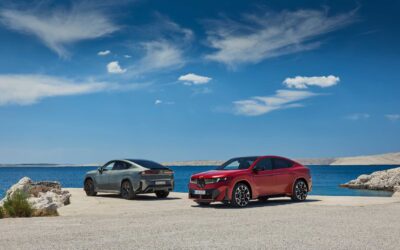

Volkswagen has revealed a near-production prototype called Mission Efficiency, and it has claimed three records certified by the Record Institute Germany for aerodynamics and energy use. The company says the car uses affordable production technology already found in its latest electric models.
What records did the car set?
The prototype took three records in the institute’s category for near-production four-seater electric cars suitable for everyday use. First, it recorded a drag coefficient of 0.158, which Volkswagen describes as a record for road-approved cars. Second, it managed 6.48 kWh per 100 km on a so-called ideal trip. Third, it became the most economical near-production electric car in its class.
The ideal trip figure came under controlled conditions. During that run, speed stayed constant at 68 km/h, there were no uphill slopes, and consumers such as the air conditioning were switched off. Naturally, real-world driving looks different, and Volkswagen tested that too.
How far did it travel on a single charge?
On a documented consumption drive, the car covered 1,278.36 km from Volkswagen’s development centre in Wolfsburg to Vienna. The route passed through Poznań in Poland and Olmütz in the Czech Republic. Along the way, the car achieved real consumption of 7.51 kWh per 100 km including charging losses, or 6.89 kWh per 100 km without them.
The trip demanded only one charging stop. The 54.9 kWh net battery was charged just once, and the car reached Vienna with 164.0 km of range remaining. The average speed was 67.72 km/h, while the top speed reached 138 km/h. Volkswagen notes that the usable battery energy was raised through software from 52.0 to 54.9 kWh, since series cars deliberately hold back capacity to protect battery life.
Which parts come from production cars?
The Mission Efficiency builds on Volkswagen’s MEB+ platform with front-wheel drive, the same basis as the ID. Polo and ID. Cross. Two features carry over directly, namely the 99 kW, or 135 PS, electric motor and the high-voltage battery. According to Volkswagen, this shows how much efficiency the company can add to its newest electric cars.
Thomas Schäfer, chief executive of the Volkswagen brand, said the car proves the point that Volkswagen wants technology for the masses. He added that the records came from affordable production technology rather than specialist hardware. Kai Grünitz, board member for technical development, said the drive system is light, very efficient and suited to the record attempt.
What does the shape do for efficiency?
Aerodynamics sit at the heart of the design. The car combines a teardrop shape, a small frontal area of 2.08 square metres, active cooling flaps, clad rear wheels and a fully clad underbody. The doors also use frameless windows, and the handles fold into the outer skin to smooth airflow.
The benefit grows with speed. Above 80 km/h, consumption runs more than 30 per cent lower than the standard ID. Polo. Indeed, at 140 km/h the Mission Efficiency needs about as much energy as the ID. Polo does at 100 km/h. Andreas Mindt, Volkswagen’s chief designer, said the body commits fully to function and echoes the earlier Volkswagen XL1. That 2013 plug-in hybrid was the most economical production car of its time.
What about the wheels and tyres?
Wheels account for 25 to 30 per cent of aerodynamic resistance, so they received close attention. At the front, the wheel arch sits tightly around the tyre to cut turbulence. In addition, patented rim deflectors on the inside of all wheels stop air entering the rims, while flat hubcaps smooth the outer surface.
Tyres played their part too. Working with Continental, Volkswagen developed a concept tyre based on the EcoContact 7. Its rolling resistance of 4.9 kilogrammes per tonne sits about 25 per cent below the threshold for the EU’s best tyre label, class A. Both the sidewall and the tread compound were reworked to reduce energy losses.
What technology sits inside and underneath?
The car uses an electromechanical brake at the rear for the first time. This cuts friction losses, removes lines and brake fluid, and supports variable brake force distribution. As a result, recuperation improves and cornering stability increases. Volkswagen developed the brake with the technology company AUMOVIO, which also supplies the ID. Polo brake system. At the front, the car keeps the ID. Polo’s MacPherson axle and hydraulic brake, and the prototype holds EU road approval.
A solar system rated at 370 W sits in the glass roof and boot lid, feeding the on-board electrics. Depending on season, region and weather, it can add up to 30 km of real range per day, according to Volkswagen’s estimate. Inside, lightweight panelling and a bring-your-own-device approach save weight, so a smartphone or tablet replaces the infotainment display.
Is it practical for a family?
At 4,775 mm long and 1,392 mm tall, the coupé offers 2+2 seating and 481 litres of boot space. Extra compartments under the rear seats and in the body sides hold everyday items and the charging cable. However, the two rear seats suit passengers up to about 1.60 m tall. Volkswagen designed the prototype so that a young family of four could, in theory, use it. The body mixes ID. Polo components with an aluminium structure and parts made from carbon fibre and aramid composite.