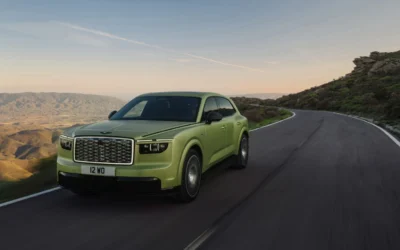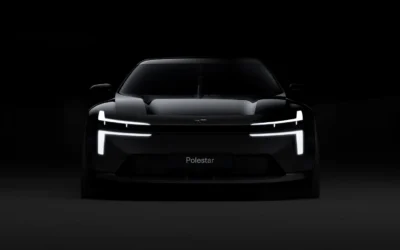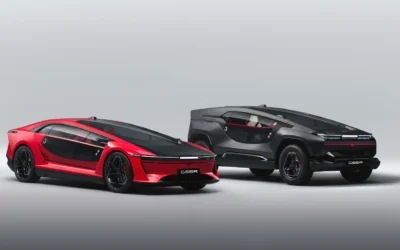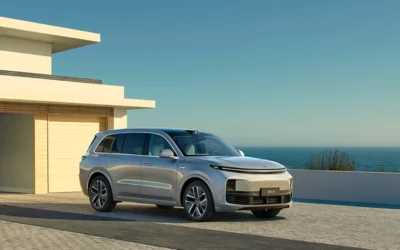

Chinese car makers now offer buyers quality, performance and prices that legacy brands struggle to match. At the Women Automotive Summit Europe in Stuttgart on 6 October, AlixPartners set out the structural reasons behind that rise.
Chinese brands took nearly 12 per cent of Europe’s new-car sales in August, a record share according to Dataforce. In the UK, more than one in five new cars sold is now Chinese. Chery’s Jaecoo brand only arrived in the UK in late 2024, yet the Jaecoo 7 was Britain’s best-selling car in March. The Gulf shows the same trend. Chinese brands held between 15 and 20 per cent of UAE new-car sales in the first nine months of 2025, according to AutoData Middle East. In the first quarter of 2026, BYD led the UAE electric car market with a 26 per cent share, ahead of Tesla.
In J.D. Power’s 2026 China Initial Quality Study, domestic brands recorded 218 problems per 100 vehicles, a count that includes design complaints as well as faults. International mass-market brands recorded 224, so Chinese brands came out ahead for the first time.
In 2023, Euro NCAP awarded five stars to BYD’s Seal and Dolphin and the Xpeng P7. Its secretary general said the new brands understood that European buyers “will not compromise on safety.” Nio’s Firefly brand followed in September 2025 with a 96 per cent adult occupant score, the highest of any car Euro NCAP had tested since the start of 2024. In a late-2025 round of tests, all four Chinese cars received five stars, with Leapmotor’s B10 scoring 93 per cent for both adult and child protection.
Performance has moved forward just as quickly. In June 2025, Xiaomi’s SU7 Ultra lapped the Nürburgring in 7 minutes 4.95 seconds, the fastest time for a production electric car. It beat the previous record set by the Rimac Nevera and also bettered the Porsche Taycan Turbo GT. Meanwhile, BYD’s Super e-Platform supports 1,000 kW charging, which BYD says adds 400 km of range in five minutes.
AlixPartners research puts the Chinese cost advantage at 35 per cent, which leaves room to undercut rivals on equipment and price.
As a result, buyers now have fewer reasons to say no to Chinese cars. The objections that may remain are mostly about the badge: brand recognition, dealer and service networks, and resale values, which still tend to trail Japanese rivals in markets such as the Gulf.
How do Chinese car makers build that advantage?
Sophie D’herbomez, a senior vice president at consultancy AlixPartners, told the Women Automotive Summit Europe that the answer lies in how these companies are organised. Her focus was speed.
“How do they develop models faster in 20 months versus traditionally 40? They develop in half of the time that we do,” she said. “They don’t just do it faster. They do it systematically faster.”
AlixPartners calculates that BYD has launched or refreshed 76 per cent of its models in the past three years. Every Xpeng model is under three years old. Geely, the slowest Chinese brand on that measure, still stands at 52 per cent. Among legacy car makers, Volkswagen performs best, yet only 34 per cent of its models are that new.
The firm also expects Europe’s light-vehicle market to grow about 1 per cent a year from 2026 to 2030. Chinese brands, by contrast, should grow by 8 per cent.
Where do Chinese car makers save the time?
AlixPartners splits the 20-month gap into three stages. Chinese teams save seven months in concept, six in engineering and seven in testing and validation.
In the concept phase, one loop of strategic approval replaces three. During engineering, suppliers join early and teams work in parallel. At least 70 per cent of components carry over from existing models. Testing uses fewer physical prototypes, a single summer and winter cycle instead of two, and two crash tests per scenario instead of four.
“Software does not need to be mature at SOP. It gets out of the critical path,” D’herbomez said, referring to the start of production. Instead, over-the-air updates fix non-critical issues and add features after launch.
Behind all of this sits a willingness to ship at a “good enough” standard wherever safety and regulation aren’t at stake. “One difference that is yet to be accepted here is that they produce only to good enough standards,” she said. Earlier AlixPartners research reached the same conclusion.
Why can’t legacy car makers simply copy the model?
D’herbomez argued that a faster process only works when the whole company changes with it. “You need the entire machine combining the three pillars, organisation, governance, and programme management to work together,” she said.
Chinese firms have fewer management layers, and their software teams report just below the chief executive. Product managers, often non-engineers, focus on the consumer and hold real decision power. Governance ranks every decision by how critical and how reversible it is, so only strategic, irreversible calls reach the top. Platforms and parts are shared heavily. China has close to 100 car brands, she noted, “yet on the streets, all the cars look more or less the same.”
In AlixPartners’ annual industry survey, 55 per cent of Chinese respondents rated their use of AI in software-defined vehicle development as mature. Most other regions remain at the pilot stage.
D’herbomez acknowledged that legal liability, regulation and labour law limit how far legacy car makers can follow. She also noted that “on a regular basis, Chinese engineers are working 40% overtime.” She made clear she doesn’t advocate copying that.
How does vertical integration help BYD compete?
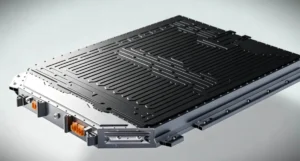
BYD shows how far the Chinese model can go when one company controls the whole chain. It makes its own batteries through its FinDreams subsidiary, and it also builds electric motors, power electronics and semiconductors in-house. AlixPartners ties the Chinese cost advantage to exactly this kind of integration, running from raw materials through components and final assembly to sales.
BYD also controls how its cars reach overseas buyers. It operates a fleet of eight car-carrier ships, including the BYD Zhengzhou, which it owns outright. A single Zhengzhou shipment unloaded nearly 5,000 vehicles. As a result, BYD depends less on outside suppliers and shipping lines at every stage, from cell production to the dockside.
That control supports the pace D’herbomez described, with 76 per cent of BYD’s range launched or refreshed in the past three years. It also underpins the company’s push abroad. In September, BYD’s overseas sales jumped 154 per cent to 180,700, almost 39 per cent of its total. Its first European car plant, in Szeged, Hungary, is due to start production in the fourth quarter.
How does Xpeng turn software into an advantage?
Xpeng represents the software side of the operating model. The company develops its driver-assistance system, in-car operating system and electrical architecture in-house, and it designs its own Turing AI chips.
This matches D’herbomez’s point that Chinese firms separate software from hardware and let it keep improving after launch. In September, for instance, Xpeng began rolling out a new version of its XOS software to customers’ cars.
Xpeng’s in-house technology is now a product in its own right. Volkswagen’s ID.UNYX 08, co-developed with Xpeng, reached production 24 months after the partnership began. Volkswagen is also the first customer for Xpeng’s VLA 2.0 driver-assistance software. Xpeng now plans to offer its chips, cockpit systems and electrical architecture to other car makers, according to people familiar with the matter. Its cars are selling abroad too, with more than 3,000 GX orders in the Middle East.
What can legacy car makers change now?
D’herbomez set out three starting points. First, accept good enough wherever safety and regulation aren’t involved, and make reuse the default. Second, invest in shared data, AI tools and clear rules for virtual validation. Third, shift from consensus to ownership, with a decision-rights matrix and a default decision when an escalation stalls.
“Clearly, such a big evolution will not be done overnight, but every little shift in the right direction helps,” she said.
Some legacy car makers are already responding, as Volkswagen’s partnership with Xpeng shows. However, Chinese car makers look set to extend their lead unless regulators limit their access to international markets. The EU has already put tariffs on Chinese-built electric cars, and Mexico raised tariffs in January 2026.