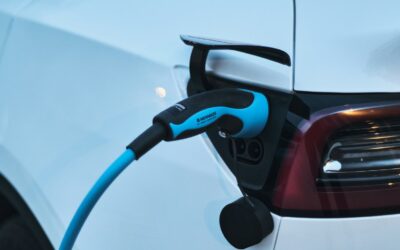

BYD has opened a desert charging station in Abu Dhabi that runs on solar power and battery storage. A robotic arm plugs the cars in. The company says a compatible car can go from 10 to 70 per cent in five minutes. It hasn’t revealed the station’s power output.
What has BYD built in the desert?
The Abu Dhabi installation brings together four technologies that have usually worked separately. These are solar panels, stationary storage batteries, BYD’s FLASH Charging system and a robot that connects the car. As a result, the driver never has to touch the cable.
BYD says it’s the first time the four have been combined in a single system. The company calls the concept SSC, short for Solar-Storage-Charging. In practice, the idea is simple. The panels generate electricity, the batteries hold it, and the charger delivers it when a car arrives.
The solar hardware comes from BYD Solar, a division with more than 16 years in the industry. According to BYD, it serves customers in over 100 countries and regions. It also has more than 300 research and development specialists and holds over 200 patents.
Stella Li, BYD’s executive vice president, said the aim is to make charging smarter and simpler for drivers.
How quickly can a car charge there?
BYD says FLASH Charging takes a car from 10 to 70 per cent in five minutes. It also claims a top-up from 10 to 97 per cent takes nine minutes. These are manufacturer figures, and nobody has verified them independently at this site. Even so, if they hold up, a stop would take roughly as long as filling a petrol tank.
Unlike most urban or motorway chargers, this desert charging station faces intense sunlight, high temperatures and scarce rainfall. BYD therefore presents it as a demonstration that the system can cope with harsh conditions.
BYD hasn’t stated the station’s power output. However, a demonstration at the site reportedly reached 1,000 kW. BYD rates its FLASH chargers at up to 1,500 kW. By comparison, many public rapid chargers deliver 150 kW. The five-minute and nine-minute times also apply only to compatible cars, which need BYD’s Second-Generation Blade Battery.
Why are the solar panels and batteries important?
A charger of that size places a heavy load on the electricity grid. That’s why the on-site batteries are central to the design. They work like a water tank. They fill slowly from the grid or the sun, then empty quickly when a car plugs in.
Because of this, each charger doesn’t need a huge grid connection behind it. BYD says the system can also run independently of the grid. That could allow stations in places where grid access is limited.
The project also follows a plan BYD has held for nearly two decades. In 2006, chairman Wang Chuanfu set out a vision linking solar power, battery storage and electric vehicles. The Abu Dhabi site puts all three in one place.
How does the robotic arm plug the car in?
The arm first locates the car’s charging port by itself. Then it opens the cover and inserts the connector. Cameras guide it, while force feedback helps the plug sit correctly.
BYD also pairs the arm with Automated Valet Parking. The driver gets out, locks the car and walks away. Next, the car drives itself to a charging bay, and the robot handles the rest.
BYD pitches this as a convenience when drivers are in a hurry or facing extreme outdoor temperatures. However, the company hasn’t said when the robotic charger will be commercially available, or what it will cost.
Where will FLASH Charging go next?
BYD’s latest announcement repeats its plan for 6,000 FLASH Charging stations worldwide by the end of 2027. The company has previously said those 6,000 would be outside China, with 3,000 in Europe. Meanwhile, it had 12,165 flash chargers in China by mid-October and aims for 20,000 there by the end of 2026.
In Spain, BYD has promised 300 chargers rated at 1,500 kW by the end of 2027. They’ll be open to any car with a CCS2 connector. The first is installed at a dealership in Leganés, near Madrid.
In addition, Alberto de Aza heads BYD in Spain and Portugal. He says the first eight chargers will be installed before the end of 2026. Still, he has acknowledged he can’t confirm all of them will be running by then. The units are ready, he says, and the wait is for administrative approval.
What questions remain?
For now, the Abu Dhabi site is a demonstration. BYD hasn’t published its power output, its storage capacity or the size of its solar array. Likewise, the charging times are the company’s own claims.
Few drivers can use these charging speeds yet. That will change only when high-volume models with the Second-Generation Blade Battery reach showrooms.