
Polestar has published its 2025 Sustainability Report, showing the clearest progress yet against its climate targets. The Swedish pure-EV brand has reduced greenhouse gas emissions per sold car by 30.9% since 2020, while growing annual retail sales to over 60,000 vehicles across 28 markets.
The figures arrive at a moment when much of the car industry is pulling back from electrification commitments. Polestar, listed on Nasdaq under the ticker PSNY, is moving in the other direction.
How much have emissions actually fallen?
In 2025, Polestar’s average emissions per vehicle sold reached 31.7 tonnes of CO₂ equivalent. That is a 7.3% reduction on 2024 and puts the company ahead of its own reduction curve. In 2024, Polestar had already beaten its 2025 target of 36.2 tCO₂e per vehicle a year early.
The company’s target is to halve emissions per vehicle sold by 2030, measured against the 2020 baseline, and to reach climate neutrality across its full value chain by 2040. Those goals cover everything from raw material extraction and battery production to logistics, use-phase emissions, and end of life.

Data provided by Polestar.
Two factors drove most of this year’s gains. First, a growing sales share of the Polestar 4, which carries the lowest carbon footprint of any model in the range. Second, declining electricity emissions in several European markets, which reduces the use-phase contribution to each vehicle’s lifetime total. Europe accounts for more than 75% of Polestar sales.
Michael Lohscheller, Polestar’s chief executive, put it plainly: “If you are not reducing emissions while growing, you are choosing not to. Electrification delivers clear value for customers: lower running costs, lower emissions and greater peace of mind, as volatile oil prices and fuel scarcity mean pump anxiety is increasingly replacing range anxiety.”
Which model has the smallest footprint?
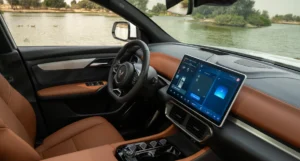
The Polestar 4 Dual Motor has a cradle-to-grave footprint of 27.6 tCO₂e, the lowest in the current lineup. It produces 400 kW and 686 Nm of torque, covers up to 590 km on a charge, weighs between 2,350 and 2,365 kg depending on configuration, and charges from 10% to 80% in 30 minutes on DC. Its battery cells are produced using renewable electricity, and key aluminium components come from smelters running on renewable power. The optional interior upholstery uses yarn made from 89% recycled PET.
For comparison, the Polestar 2 Long Range Dual Motor comes in at 28.3 tCO₂e across its full lifecycle. It offers 310 kW, 740 Nm of torque, a 596 km range, and a kerb weight of 2,108 to 2,185 kg. Its production plant runs entirely on renewable energy, using on-site solar, certified renewable electricity and biogas.
The Polestar 3 Dual Motor has a footprint of 32.6 tCO₂e cradle to grave, reflecting its larger size and weight of 2,490 to 2,600 kg. It produces 400 kW and 840 Nm, achieves a 635 km range, and charges from 10% to 80% in 22 minutes. The Polestar 3 was named the safest Executive Car of 2025 by Euro NCAP.
The Polestar 5, Polestar’s flagship GT, is not yet in production. Pre-production data gives a projected lifecycle footprint of 30.1 tCO₂e. It delivers 550 kW, 812 Nm of torque, a 678 km range, and a kerb weight of 2,462 to 2,500 kg. It charges from 10% to 80% in 22 minutes. Eighty-three percent of its aluminium comes from smelters using renewable electricity.
Across the range, at least 50% of the cobalt in Polestar 2 and Polestar 3 batteries is recycled, verified against ISO 14021 standards from supplier data rather than industry averages.

The Polestar 3
What happened to the 2030 climate-neutral car target?
The Polestar 0 project, launched in 2021 as a cross-industry call to develop a car that eliminates greenhouse gas emissions entirely without relying on offsets, originally aimed for a 2030 delivery. That target has been revised. Polestar now acknowledges the 2030 goal will not be met, citing macroeconomic pressures, platform strategy changes, and uneven engagement across the industry. The revised aim is a climate-neutral car by 2035.
Rather than step back from the work, Polestar has formalised it. Mission 0 House, based in Gothenburg, was officially established in 2025 with close to SEK 100 million in research funding secured over five years. The consortium brings together five Swedish universities and six companies, working across metals, chemicals, and manufacturing processes.
Fredrika Klarén, Head of Sustainability at Polestar, said: “The Polestar 0 project pushes us into new territory. While much of the industry invests in hybrids and combustion engines, we focus on solutions that eliminate emissions entirely.”
Current work includes a large-scale pilot for ultra-low-emission steel, research into bio-based textile alternatives, and technologies that convert CO₂ into new materials.
What is coming next from Polestar?
A new generation of the Polestar 2 is in development, described as a successor that will build on the original’s design character and sustainability approach. An expanded Polestar 4 variant is also due, with deliveries expected toward the end of 2026.
Further out, the Polestar 7 compact SUV is planned for 2028, with manufacturing in Europe. It will enter a segment that represented around one third of all battery EV sales in Europe in 2025.
The full Polestar 2025 Sustainability Report is available at polestar.com.