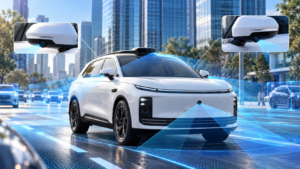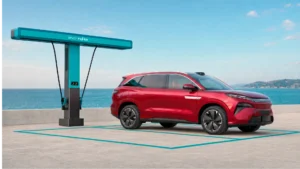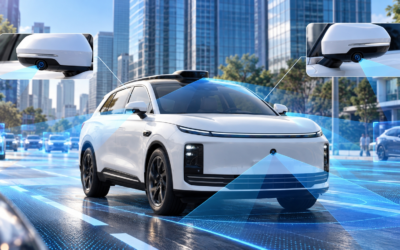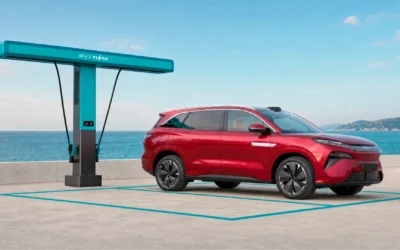

Lucid and Bolt have announced a partnership to build and deploy autonomous electric cars across Europe. The ride-hailing platform plans to run at least 25,000 self-driving Lucid EVs on its network. It ranks among the largest robotaxi fleet commitments announced in Europe so far.
What exactly have the two companies agreed?
Bolt is Europe’s largest shared-mobility platform. It counts more than 200 million customers, 4.5 million drivers and couriers, and operations in over 50 countries and 850 cities.
The company describes the 25,000 vehicles as a major step toward a bigger goal. Specifically, it wants 100,000 autonomous vehicles on its platform by 2035.
These cars will be built on Lucid’s upcoming Midsize platform and designed for SAE Level 4 autonomy. In addition, the two firms plan to co-develop an ADS-ready vehicle from the product stage.
The vehicle is expected to use NVIDIA Hyperion, a production-ready reference architecture. This bundles high-performance compute with a standard sensor suite.
Who does what in this partnership?
Bolt is taking the operator role. Its dedicated unit, Bolt Autonomous Driving Solutions, will define the vehicle, software and safety requirements.
The unit will also build the fleet infrastructure and city partnerships. It intends to own and operate the fleet itself.
On Lucid’s side, the work runs through the newly created Lucid Technologies. This pulls the company’s AI, driver-assistance and autonomy efforts under one roof.
Lucid chief executive Silvio Napoli said shared autonomous mobility gives Lucid a chance to extend its technology beyond consumer vehicles. Meanwhile, Bolt founder and chief executive Markus Villig framed autonomous driving in Europe as a systems problem requiring data, software, vehicles and operations to work as one.
Is this Lucid’s first robotaxi deal?
No. In fact, it is the second big autonomous-fleet deal Lucid has signed in just over a year.
In July 2025, Uber committed to deploying 20,000 Lucid Gravity robotaxis in the United States, running Nuro’s Driver system. That deal also came alongside a 300 million dollar investment.
Since then, Uber has built its stake in Lucid up to roughly 11.5 per cent. On paper, therefore, Lucid now holds commitments for 45,000 autonomous vehicles across two continents.
However, the Bolt deal has a different shape. It covers Europe rather than the United States, the Midsize platform rather than the Gravity SUV, and NVIDIA Hyperion rather than Nuro.
What is Lucid actually supplying?
In both deals, Lucid is supplying the vehicle. Hyperion, meanwhile, is compute and sensors rather than a self-driving system.
The announcement says the partners will still work with autonomous-driving technology partners to make Level 4 work. Consequently, the software that turns a Lucid into a robotaxi remains an open question.
Is the platform ready to build these cars?
Not yet. The Midsize platform these 25,000 vehicles depend on does not exist, and Lucid has pushed it back.
On 4 August, in its second-quarter operational reset, Lucid delayed the Midsize programme. That reset has defined the company’s year.
Napoli became permanent chief executive on 1 June. Later in June, the company cut 18 per cent of its workforce, about 1,500 jobs, and withdrew its 2026 production guidance.
Lucid also delivered just 3,953 vehicles in the second quarter. Neither company gave a deployment date for the Bolt fleet, and Bolt’s 100,000-vehicle target sits a decade out, in 2035.
What does this mean for the wider picture?
Bolt is a real platform with real scale. In addition, operating data from 850 cities is exactly the kind of asset a serious autonomy operator needs.
Still, two points stand out. Lucid keeps announcing enormous autonomous-fleet numbers while it lays people off, pulls its own guidance and delays the very product these fleets rely on.
First there were 20,000 vehicles with Uber, and now 25,000 with Bolt, from a company that made fewer than 4,000 cars in the second quarter. In every one of these deals, Lucid supplies the hardware while the autonomy comes from elsewhere.
Therefore, even though these are meaningful demand drivers, the demand will only arrive once these companies solve autonomy at scale. So far, that has yet to happen.