
The UAE has moved quickly from a period of free, patchy public charging to a well-regulated, commercially structured ecosystem. Whether you drive a Tesla, a BYD, or a NIO, the network has expanded to the point where range anxiety is no longer the defining concern it once was for prospective buyers. This guide covers every layer of UAE charging infrastructure in 2026, from public networks and home installation to highway megahubs and battery swap technology.
Who runs the public charging network?
Public EV charging in the UAE operates through regional utility providers and commercial operators rather than a single national authority. Three entities shape the bulk of the infrastructure.
Dubai: DEWA and the Green Charger network
The Dubai Electricity and Water Authority (DEWA) launched its EV Green Charger initiative in 2014, the first public EV charging network in the region. By mid-2025, Dubai had more than 1,270 charge points across the city, delivered in partnership with public and private sector operators. That is likely over 1500 now as the roll-out has continued. More than 40,600 electric vehicles were registered in Dubai by the end of the first half of 2025, according to DEWA’s CEO HE Saeed Mohammed Al Tayer, who confirmed a 23.6 percent rise in Green Charger usage in Q1 2025 compared to the same period in 2024.
A regulatory and licensing framework introduced in 2024 now allows independent Charge Point Operators (CPOs) to develop and run stations alongside DEWA’s own network, opening the market to private investment for the first time at scale.
Abu Dhabi: ADNOC and TAQA
In Abu Dhabi, the Al Ain Distribution Company and the Abu Dhabi Distribution Company manage infrastructure through the TAQA Distribution network. The long-term ambition is considerable: ADNOC and TAQA are together targeting 70,000 charge points across Abu Dhabi by 2030, aligned with the Abu Dhabi Economic Vision 2030.
ADNOC’s commercial charging arm, E2GO, had over 400 charge points installed across the UAE by end of 2025, with a target of 750 by 2028. E2GO uses AI-powered Plug and Charge technology. Once a car is registered, it is automatically recognised when plugged in and billing is handled without a card or app.
Federal: UAEV
UAEV is a joint venture between the Ministry of Energy and Infrastructure and Etihad Water and Electricity. Its primary focus is the Northern Emirates, where infrastructure density has historically trailed Dubai and Abu Dhabi. UAEV’s goal is to deploy 1,000 chargers across the country by 2030, operating a vehicle-agnostic network covering multiple charging speeds.
National expansion targets
|
Entity |
Current Status |
2030 Target |
|
DEWA (Dubai) |
1,270+ charge points (mid-2025) |
Continued optimisation |
|
UAEV (Federal) |
Active rollout, Northern Emirates |
1,000 chargers |
|
ADNOC / TAQA (Abu Dhabi) |
Core hubs active |
70,000 points |
|
E2GO (ADNOC commercial) |
400+ charge points |
750 by 2028 |
What does it cost to charge?
Free public charging ended across the UAE in 2024. Cabinet Resolution No. 81 of 2024 introduced a unified tariff structure applying to all public CPOs.
Pricing is split by technology. AC (Level 2) charging costs 0.70 AED per kWh, or 0.735 AED including VAT. DC fast and ultra-fast charging costs 1.20 AED per kWh, rising to 1.26 AED with VAT. For a 60 kWh battery charged from near-empty, that works out to roughly 44 AED on an AC charger and 76 AED on a DC fast hub.
| Charging type | Technology | Base rate (AED/kWh) | With 5% VAT |
| Standard | AC (Level 2) | 0.70 | 0.735 |
| Express | DC fast / ultra-fast | 1.20 | 1.26 |
In Abu Dhabi, homeowners who install a charger but are waiting for a dedicated sub-meter pay a flat 92 AED per month. Once the meter is active, home charging is billed at 30 fils (0.30 AED) per kWh, a significant saving over public rates.
Tesla Supercharger rates align with commercial DC pricing, broadly in line with the 1.20 AED per kWh standard DC tariff. Tesla also applies an idle fee of 2.00 to 4.00 AED per minute if a car remains plugged in after charging completes.
How do you pay?
Under DEWA’s 2025 EV Charging Regulations, all public operators must offer a pay-as-you-go option. No UAE public charger can be restricted to subscription-only access.
Three payment methods are in common use. Registered DEWA or ADDC customers link their EV to their utility account, pay a refundable 500 AED security deposit and a one-off 20 AED card delivery fee, and initiate sessions via a physical RFID card or the utility’s app. Charging costs are added to the monthly electricity bill. Non-registered users scan a QR code on the charger to access Guest Mode, entering payment details directly. The system places a temporary hold and charges only for actual kWh consumed at the end of the session. Tesla handles its own automated billing through the vehicle account, with no separate registration required.
Can you charge at home?
Home charging is typically the most cost-effective option for EV owners. The standard setup is a Level 2 AC wallbox, rated at 7 kW or 11 kW, delivering a full charge in six to ten hours overnight. Almost every EV sold in the UAE uses a Type 2 connector, compatible with all Level 2 wallboxes currently available.
A home installation is a regulated electrical upgrade, not a plug-and-play exercise. It requires a certified contractor and formal approval from DEWA or ADDC. The property’s distribution board must first be assessed for available load capacity. Older properties may need a panel upgrade before installation can begin. The charger itself must carry at least an IP65 ingress protection rating to withstand UAE heat, dust, and sand.
What does a home installation cost?
|
Cost category |
Estimated range (AED) |
Timeline |
|
Charger hardware |
2,500 to 6,000 |
Immediate purchase |
|
Labour and civil works |
1,500 to 3,500 |
2 to 6 hours on-site |
|
Permits and admin fees |
500 to 1,000 |
3 to 7 working days |
|
Total |
5,000 to 10,000 |
1 to 2 weeks overall |
PlusX Electric, Shamsplug, and Eurosec are among the established installers offering end-to-end services, covering permit handling, site inspection, and post-installation maintenance. Premium packages typically include two years of preventive maintenance.
What if you live in an apartment?
Apartment residents cannot directly control their building’s electrical infrastructure. This makes home charging considerably more involved than for villa owners.
The first requirement is a No-Objection Certificate (NOC) from the building management or the Owners’ Association. Building managers often raise concerns about load capacity, fire safety, and equitable electricity distribution. To obtain an NOC, a resident generally needs to demonstrate exclusive use of a designated parking space, appoint a DEWA or ADDC-approved contractor who can provide a wiring diagram, and sign an indemnity agreement covering future maintenance issues.
Dubai Municipality’s Green Building Regulations now require new developments to dedicate a proportion of parking to low-emission vehicles. A Silver-rated building must allocate five percent of spaces, a Gold-rated seven percent, and a Platinum-rated building ten percent.
For existing buildings, a practical alternative has emerged. Third-party CPOs can now install shared Community Chargers in basement car parks under the 2024 regulatory update. Residents access them via an app-based booking system, avoiding the need for individual wiring runs and separate NOC processes.
Where multiple EVs share the same building supply, Dynamic Load Management (DLM) systems have become the standard technical solution. DLM monitors the building’s total power draw in real time. During peak evening periods when air conditioning loads are highest, the system automatically reduces output to EV chargers to prevent overload, before restoring full power overnight. Buildings can support more EVs without expensive transformer upgrades.
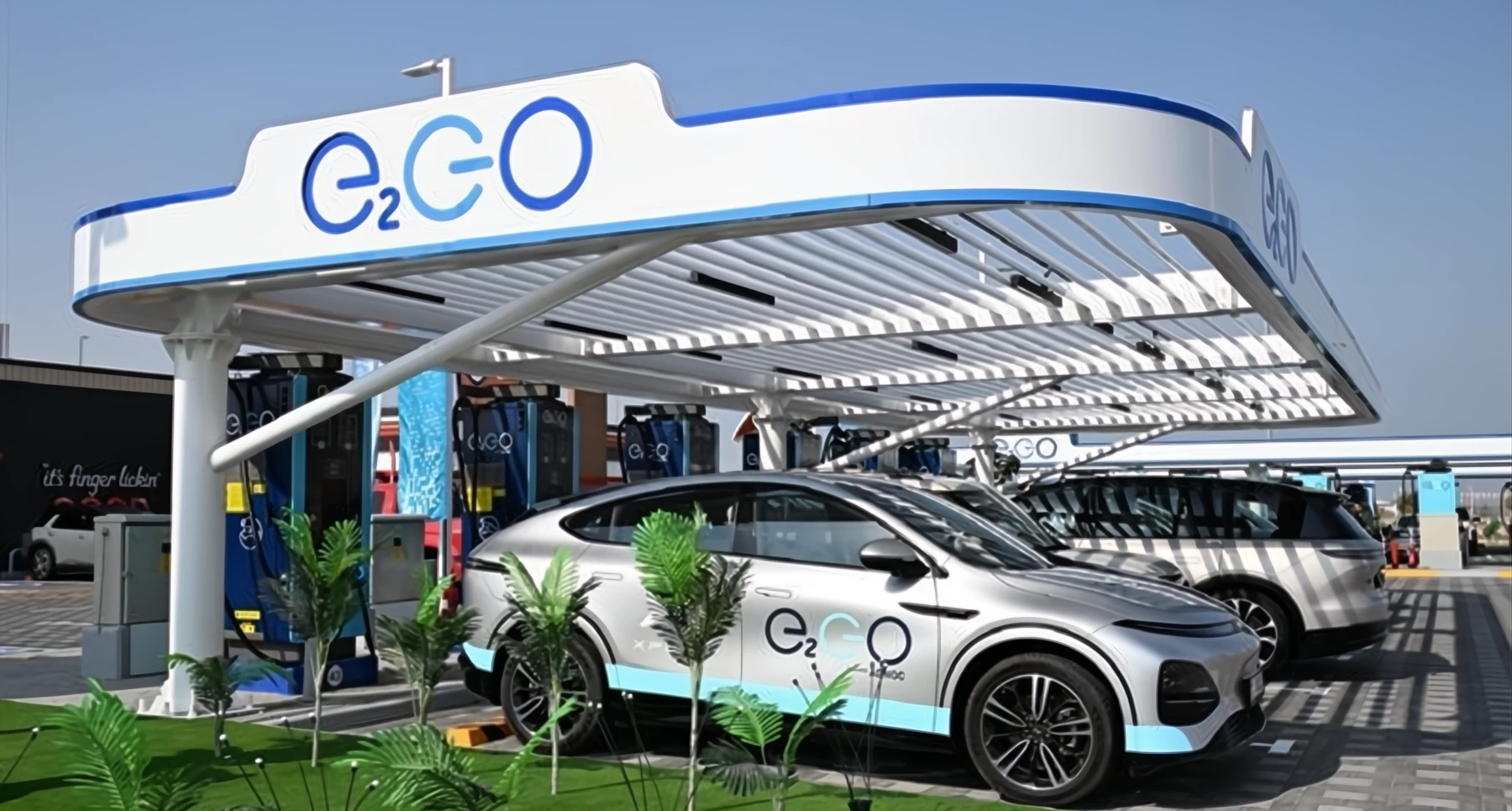
The new hub on the E11
What about driving between cities?
The E11 highway between Abu Dhabi and Dubai is now a viable route for any EV. The ADNOC EV Megahub at Saih Shuaib, opened in January 2026, is the largest superfast charging facility in the Middle East, Africa, and Turkey, and the sixth-largest in the world.
The hub has 60 high-speed chargers capable of taking most EVs from zero to 80 percent charge in approximately 20 minutes. It is also the first Hub by ADNOC location designed specifically for intercity commuters, combining coworking space, food outlets, and retail in a footprint three times larger than a conventional service station.
“We are redefining convenience to ensure they can travel confidently across the country, supported by our growing E2GO network,” said Eng. Bader Saeed Al Lamki, CEO of ADNOC Distribution, at the January 2026 launch.
Eng. Sharif Al Olama, Undersecretary for Energy and Petroleum Affairs at the Ministry of Energy and Infrastructure, described the opening as “a significant step in implementing the UAE’s National Electric Vehicles Policy and advancing our vision for sustainable mobility across the nation.”
Under the highway electrification roadmap, ADNOC Distribution plans to open 20 EV charging hubs by the end of 2027, with 15 of those expected to be operational by the end of 2026, providing coverage across all core UAE national highways.
Is battery swapping available?
NIO owners have an option that bypasses charging entirely. At a NIO Power Swap Station, an automated system removes the vehicle’s depleted battery and replaces it with a fully charged one in approximately three minutes.
The first swap station in the UAE opened at Yas Marina Circuit in Abu Dhabi in February 2025. It uses PSS 3.0 technology, stores up to 21 batteries, and can process over 400 swaps per day. A single swap costs between 99 and 119 AED depending on battery capacity (75 kWh or 100 kWh). NIO is actively scouting a second station location in Dubai, though each facility requires at least 250 kW of dedicated power supply, which makes site selection more complex than for standard chargers.
What about mobile charging?
CAFU, the UAE on-demand vehicle services platform, announced in October 2024 that it planned to add EV charging to its app-based offering in 2025, including a mobile premium service and a trailer-based pop-up option. It also named Audi Middle East as a launch partner. As of publication, the service does not appear to have gone live in the UAE. EVLife will update this section when a commercial launch is confirmed.

The NIO Power Swap station at Yas Island.
How do the options compare?
| Home (Lev.2) | Public AC | Public DC fast | NIO battery swap | |
| Typical time | 6 to 10 hours | 2 to 4 hours | 20 to 50 minutes | 3 minutes |
| Cost per 60 kWh | ~24 AED | ~44 AED | ~76 AED | 99 to 119 AED |
| Best for | Daily overnight use | Malls and hotels | Intercity travel | NIO owners |
Finding a charge point
DEWA’s full network is mapped on its smart app and website, available across 14 digital platforms. For a dedicated station finder covering the broader UAE, Drive EV’s charging station directory is a practical reference tool with live location data.
What comes next?
The next phase of UAE EV infrastructure centres on Vehicle-to-Grid (V2G) technology and smart grid integration. V2G allows an EV battery to discharge electricity back into the building or national grid during high-demand periods, turning parked cars into distributed storage assets. Pilot programmes are active in Dubai and at Masdar City in Abu Dhabi.
During the UAE summer, cooling loads place significant strain on the grid. V2G is expected to become a structural part of the national power system by 2026, helping balance the intermittency of large-scale solar generation.
DEWA is investing seven billion AED in its smart grid strategy through 2035. A substantial portion covers AI and data analytics systems that predict energy availability in real time and adjust public charger output to match solar generation. Under the Shams Dubai programme, PV installation data is already integrated with the charging network, ensuring that green charging draws from solar during peak sun hours.
For EV owners, the practical implication is that chargers will increasingly automate their own scheduling. Future-ready units will shift charging to off-peak overnight periods automatically, reducing costs for the user and protecting the grid from overload.
For a live map of public charge points across the UAE, visit Drive EV’s charging station directory.