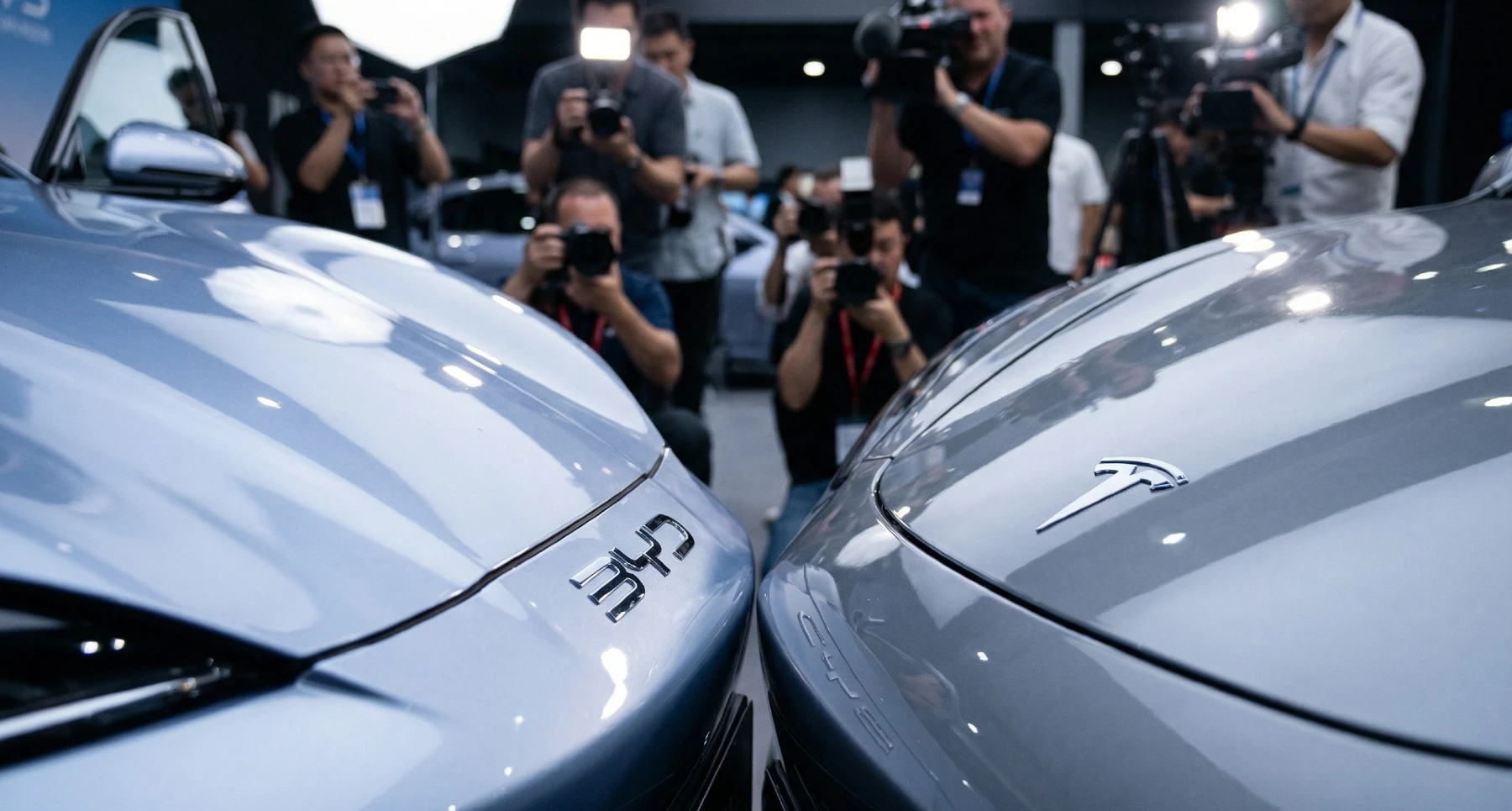
Two brands now dominate conversations about electric vehicles in the UAE. BYD has arrived with a wide model range, aggressive pricing, and a plug-in hybrid lineup that Tesla cannot match. Tesla holds its ground on charging infrastructure, software maturity, and resale values. This guide compares them directly across every category that matters to UAE buyers.
What is the headline difference between the two brands?
BYD suits buyers who want the most car for their money, or who want hybrid flexibility alongside electric range. Tesla suits buyers who want the best charging network in the UAE, the most mature driver-assistance technology, or a stronger resale position.
Both are strong choices. The right decision depends on how you use the car, whether you can charge at home, and how much the purchase price matters.
How do the two brands compare at a glance?
|
Category |
BYD |
Tesla |
|
Entry price in UAE |
AED 74,900 (Qin Plus hybrid) |
AED 144,990 (Model 3) |
|
Fully electric entry |
AED 89,900 (Dolphin, confirm at byduae.ae) |
AED 144,990 (Model 3) |
|
Hybrid models available |
Yes, 7 Super Hybrid models |
No |
|
UAE charging network |
Public (DEWA, ION, Charge2Moov) |
Proprietary Supercharger plus public |
|
Over-the-air updates |
Yes, improving rapidly |
Yes, frequent and significant |
|
Driver-assistance |
DiPilot ADAS, God’s Eye on newer models |
Autopilot plus FSD option |
|
Battery chemistry |
Blade LFP |
NCA or LFP depending on model |
|
UAE distributor |
Al-Futtaim Electric Mobility |
Tesla direct |
|
Resale value (UAE) |
Still establishing |
Stronger, more established |
How do BYD and Tesla compare model by model?
The two brands have three natural match-ups in the UAE market: sports sedan, mid-size SUV, and luxury sedan.
Sports Sedan: BYD Seal vs Tesla Model 3
|
Spec |
BYD Seal AWD |
Tesla Model 3 Performance |
|
Starting price |
AED 149,900 (base FWD) |
AED 144,990 (base RWD) |
|
Top trim price |
AED 204,900 (AWD) |
AED 214,990 (Performance) |
|
Power |
523 HP |
Up to 460 HP |
|
0 to 100 km/h |
3.8 seconds |
3.1 seconds (Performance) |
|
Range (WLTP) |
Up to 570 km |
Up to 629 km |
|
Battery |
Blade LFP |
LFP or NCA |
At entry trim, the BYD Seal and Tesla Model 3 are at near price parity, with the base Model 3 marginally cheaper. At the performance end, the Seal AWD (AED 204,900) undercuts the Model 3 Performance (AED 214,990) by AED 10,000.
The Seal delivers more power at the top trim and a more expressive interior, with BYD’s rotating display and dramatic design language. The Model 3 reaches 100 km/h faster in Performance guise. Tesla’s Autopilot and Full Self-Driving are not available on the Seal. Over-the-air updates mean the Model 3 continues to develop after purchase. The Supercharger network makes long-distance travel more straightforward.
For drivers who want the stronger software and easier long-distance charging, the Model 3 earns its place. For drivers who want more power at the performance end, a dramatic cabin, and a slight price advantage at the top trim, the Seal is hard to overlook.
Mid-Size SUV: BYD Sealion 7 vs Tesla Model Y
|
Spec |
BYD Sealion 7 |
Tesla Model Y |
|
Starting price |
AED 172,900 |
AED 178,670 |
|
Top trim price |
AED 193,000 |
AED 243,670 |
|
Range (WLTP) |
Up to 482 km (RWD) |
Up to 600 km |
|
Fast charging |
Up to 150 kW DC |
Up to 250 kW (Supercharger) |
|
Seating |
5 |
5 (7-seat option available) |
This is the most commercially significant matchup in the UAE market. The Tesla Model Y is among the country’s best-selling electric cars. The Sealion 7 is BYD’s most direct response.
At entry level, the two cars are separated by roughly AED 5,770 in Tesla’s favour. At the top trim, the Model Y Performance (AED 243,670) is AED 50,670 more than the Sealion 7 Performance (AED 193,000). The Sealion 7 offers more equipment as standard and rides on BYD’s proven Blade Battery. Interior quality has surprised reviewers who expected a significant gap versus Tesla.
The Supercharger network remains the decisive factor for many UAE buyers. Tesla’s stations in Dubai and Abu Dhabi are fast and widely available, making inter-emirate road trips straightforward. The Model Y also carries a 7-seat option and a significantly stronger used-car position.
For buyers who charge at home and commute within Dubai or Abu Dhabi, the Sealion 7 represents strong value. For buyers who travel regularly between emirates or prioritise resale, the Model Y justifies its premium.
Luxury Sedan: BYD HAN vs Tesla Model S
|
Spec |
BYD HAN |
Tesla Model S |
|
Starting price |
AED 199,900 |
AED 393,670 |
|
Top trim price |
AED 231,900 |
AED 428,670 (Plaid) |
|
Power |
Up to 509 HP |
Up to 1,020 HP (Plaid) |
|
0 to 100 km/h |
3.9 seconds |
2.1 seconds (Plaid) |
|
Range (WLTP) |
Up to 565 km |
Up to 634 km |
The price gap is the largest of any direct comparison in the UAE market. The BYD HAN starts from AED 199,900. The Tesla Model S starts from AED 393,670, a difference of nearly AED 194,000 at entry level.
The HAN covers executive territory convincingly. Its 509 HP, 3.9-second 0 to 100 time, ambient lighting, rotating display, and Nappa leather interior all sit at a standard the price suggests. For buyers moving from a Lexus LS or Genesis G90, the HAN feels appropriate. The Model S Plaid is in a different performance category with its 1,020 HP and 2.1-second sprint. Tesla’s over-the-air updates and Supercharger access are meaningful here as they are across all Model S ownership. At this price point, brand prestige also carries weight for some buyers.
Absent a specific requirement for Plaid performance or the Tesla name, the HAN represents the most compelling value argument of any BYD versus Tesla comparison available in the UAE today.
Where is the price difference most significant?
Across most segments, BYD prices are below Tesla. BYD’s cheapest model starts at AED 74,900. Tesla’s cheapest starts at AED 144,990. The gap between the two brand entry points is AED 70,000.
For fully electric models at comparable segments: BYD’s ATTO 3 (AED 94,900) sits AED 83,770 below the entry Model Y (AED 178,670). The BYD HAN (AED 199,900) is AED 193,770 below the entry Model S (AED 393,670). The Seal and Model 3 are at near parity at base trim, with BYD cheaper at the performance end.
BYD’s Super Hybrid range has no Tesla equivalent. Tesla sells only fully electric vehicles. For buyers who want a plug-in hybrid with genuine electric-only range and a petrol engine for longer trips, BYD is the only option of the two brands.
Which brand has better range and battery technology?
Both brands deliver class-competitive real-world range on their electric models.
BYD’s Blade Battery uses lithium iron phosphate chemistry. LFP is heavier than the nickel cobalt aluminium chemistry Tesla uses in its longer-range variants, but it is more thermally stable, degrades more slowly over time, and tolerates 100 percent state-of-charge without the battery management restrictions that apply to NCA cells.
For UAE operating conditions, with ambient temperatures regularly exceeding 40°C, thermal stability has practical consequences. Real-world data from comparable Gulf markets suggests BYD’s battery degradation over time is lower than early estimates. Tesla’s longer-range variants achieve higher energy density, which is why the Model S Long Range reaches 634 km WLTP against the HAN’s 565 km. NCA cells require more careful thermal management and degrade more quickly under sustained fast charging.
For daily UAE use, both brands offer sufficient range. The difference becomes relevant on long-distance trips, where Tesla’s Supercharger network is the more decisive factor than battery chemistry.
Who has the better charging network in the UAE?
Tesla holds a clear advantage here. It operates its own Supercharger stations across the UAE, with units in Dubai and Abu Dhabi. V3 Superchargers deliver up to 250 kW, with real-world speeds sufficient to add around 250 km of range in roughly 20 minutes. The network is reliable and designed to work seamlessly with Tesla vehicles.
BYD vehicles use the public charging network: DEWA Green Charger, ION, Charge2Moov, and compatible stations. UAE public charging infrastructure has expanded and continues to grow, but it is less consistent than Tesla’s proprietary network. Charging speeds vary considerably by location.
In practice, Tesla owners driving Abu Dhabi-Dubai routes or taking weekend trips to Fujairah or Al Ain can plan without checking charger availability in advance. BYD fully electric owners need to plan more carefully. BYD’s Super Hybrid models remove this concern entirely. Their petrol backup means charging availability is never a constraint on where you travel.
Which brand has the stronger technology and software?
Tesla currently leads on software maturity, but BYD is closing the gap faster than its reputation in this area suggests.
Tesla pushes over-the-air updates wirelessly, often adding features and improving performance without a service centre visit. A Model Y bought in 2024 behaves differently today as a result of software changes alone. Tesla’s Autopilot is among the most capable driver-assistance systems available for motorway driving, and Full Self-Driving is available as an optional upgrade. Tesla’s app for remote pre-conditioning, charge scheduling, and battery management is mature and reliable.
BYD’s OTA capability is real and has been delivering meaningful improvements. Recent updates have added measurable range increases, improved fuel economy on hybrid models, a trip charging planner, and voice assistant upgrades. BYD has also pushed its God’s Eye smart driving system to over one million vehicles via OTA, including more affordable models, at no extra cost. The pace of development in this area is accelerating. The gap with Tesla is real, particularly for export-market vehicles where the full Chinese feature set may arrive later, but describing BYD’s software as static would be inaccurate.
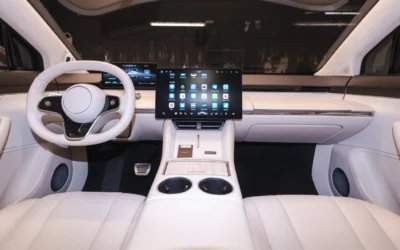
On the physical side, BYD retains buttons and dials for key functions. In the heat of a UAE summer, physical climate controls have a practical advantage over touchscreen-only systems. BYD’s large rotating displays and premium audio installations are impressive at their price points. The app works well for core functions but lacks the depth and polish of Tesla’s platform.
For drivers who prioritise the most advanced driver-assistance and a technology-first ownership experience today, Tesla is the stronger choice. The distance between the two brands on software is shrinking.
How does after-sales service compare?
Tesla operates its own service centres in Dubai and Abu Dhabi, with mobile service vans for minor repairs and diagnostics. Its direct-sales model means buyers deal with Tesla for everything, from purchase to servicing. Parts availability has improved, but lead times on specialist components can still be lengthy for complex repairs, as some owners have noted.
BYD is serviced through Al-Futtaim Electric Mobility, one of the most established automotive groups in the region. Al-Futtaim’s workshops, trained technicians, and parts supply infrastructure are built on decades of experience across high-volume brands. For buyers who want a familiar and well-resourced dealership experience, BYD’s service network is arguably more accessible.
Both brands offer standard warranties. Service intervals on electric vehicles are considerably lower than petrol equivalents, with no oil changes, timing belts, or transmission fluid to contend with.
Which brand holds its value better in the UAE?
Tesla currently holds stronger resale values on the UAE used car market. The brand has been present longer, the secondary market is well established, and used Tesla pricing is broadly predictable.
BYD’s resale position is newer and less defined. Models that have been on UAE roads for two to three years, the ATTO 3 and Seal among them, are beginning to establish a secondary market. Values are less predictable for now. As BYD’s presence grows and Al-Futtaim’s service infrastructure matures, the resale position should strengthen. Buyers who plan to sell or trade in within three to five years should factor the difference into their total cost of ownership.
Who is BYD best suited to?
BYD makes the most sense for buyers who want the most specification per dirham, or who are not ready to commit fully to electric and want the flexibility of a Super Hybrid model. It suits buyers who charge at home or at work and stay within the metro areas of Dubai or Abu Dhabi, where the public charging network covers daily needs. Buyers looking for a 7-seat family SUV at a more accessible price, or for a luxury sedan at far below European premium pricing, will find BYD’s range hard to dismiss. It also suits buyers who find Tesla’s interior too minimal and want a more expressive cabin.
Who is Tesla best suited to?
Tesla makes the most sense for buyers who drive regularly between emirates and want a stress-free fast-charging experience. It suits buyers who value over-the-air updates, Autopilot, and a technology-driven ownership experience. Buyers who plan to sell or trade in within three to five years and want predictable resale values have a clearer track record to rely on with Tesla. It also suits buyers who want an established all-electric brand with the longest local presence in the UAE, or who prefer a minimalist single-screen interface.
Frequently Asked Questions
Is BYD cheaper than Tesla in the UAE?
Across most segments, yes. BYD’s cheapest model starts at AED 74,900 against Tesla’s AED 144,990. For electric SUVs, the BYD ATTO 3 (AED 94,900) is roughly AED 84,000 below the entry Model Y (AED 178,670). For sports sedans, the two brands are at near price parity at entry level, with BYD cheaper at the performance trim. For luxury sedans, the BYD HAN (from AED 199,900) sits nearly AED 194,000 below the entry Model S (AED 393,670).
What is the cheapest BYD electric car in the UAE?
The BYD Dolphin is available in the UAE from AED 89,900, making it the most affordable pure electric BYD on the market. Confirm availability and current pricing through the official distributor at byduae.ae, as the Dolphin does not currently appear in the listed Al-Futtaim lineup. The ATTO 3, from AED 94,900, is the cheapest electric model confirmed through the official channel.
Does BYD have Superchargers in the UAE?
No. BYD vehicles use the UAE public charging network, including DEWA, ION, and Charge2Moov stations. Tesla operates its own Supercharger network in Dubai and Abu Dhabi, which is faster and more reliable for long-distance travel. BYD’s Super Hybrid models remove this concern, as they carry a petrol engine alongside the battery.
Which holds its value better in the UAE: BYD or Tesla?
Tesla currently holds stronger resale values. BYD’s secondary market in the UAE is still establishing itself as the brand grows its presence through Al-Futtaim.
Does Tesla offer hybrid cars in the UAE?
No. Tesla sells only fully electric vehicles. BYD offers both fully electric models and plug-in hybrids under its Super Hybrid range.
Is BYD build quality comparable to Tesla in the UAE?
Current-generation BYD models, including the Seal, HAN, and ATTO 8, have closed the gap substantially. Independent road tests note that the Seal competes with the Model 3 in day-to-day use. Both brands have received criticism at various points: Tesla for panel gaps and paint consistency on earlier models, BYD for interior materials on older variants. Both have improved.
Which handles UAE heat better: BYD or Tesla?
Both are engineered for hot climates. BYD’s Blade Battery LFP chemistry is more thermally stable than the NCA cells used in Tesla’s higher-range variants. All UAE-specification models from both brands include enhanced battery cooling. Real-world data from comparable Gulf markets suggests BYD’s battery degradation under sustained heat is lower than initial estimates.