
Most US adults in a BMW Group survey say 75 miles or less covers their day, yet 42 per cent want at least 300. Working out how much EV range you need starts with your longest regular trip.
BMW Group polled 1,005 adults in September. Seventy-three per cent chose 25, 50 or 75 miles (about 40, 80 or 120 km) as enough for their daily routine. However, 42 per cent would want 300 miles (about 480 km) or more before considering an EV. That group includes 18 per cent who want at least 400 miles.
Alexander Schleicher is Head of E-Mobility at BMW Group North America. He says shoppers now judge EVs on “performance, features and value, not on outdated assumptions about range”. BMW also has long-range cars to sell. Its electric iX5, due to start production in South Carolina before the end of 2026, promises up to 435 EPA-estimated miles.
Is the gap only an American one?
BMW’s poll covers the US alone, but International Energy Agency figures show a similar pattern worldwide. Battery electric cars averaged close to 400 km of on-road range in 2025. By contrast, the IEA puts average daily driving at about 40 km, roughly a tenth of that. Some models now exceed 600 km, although they typically cost more.
Why do people want so much more than they drive?
The IEA says occasional long trips loom large when consumers weigh up switching. In BMW’s survey, 72 per cent call minimum range a deciding factor. Men are more likely to say so than women, at 80 per cent against 64 per cent. Half of men also prefer 300 miles or more, compared with 35 per cent of women.
Ownership may ease some of that worry. US battery analyst Recurrent polled more than 250 EV drivers and shoppers in 2023. It found anxiety about range peaked one to two years before a first purchase. While 76 per cent of future owners worried, nearly 59 per cent of current drivers reported no anxiety. That sample is small and older than BMW’s. Even so, respondents stayed more anxious about long trips than daily drives. Recurrent links that to reliance on public charging.
What does a long trip look like in practice?
The IEA has modelled a car with 400 km of mixed-use range. Motorway speeds reduce efficiency, so it covers around 320 km on its first leg. That takes it from full down to 10 per cent, in almost three hours at an average of 110 km/h. A 25-minute stop at a 150 kW charger then adds over 200 km, or about two more hours of driving. At 250 kW, the same stop adds over 250 km. Anyone planning long-distance driving can use that as a rough guide.
Coverage varies by country. In 2024, close to 60 per cent of EU highways had an ultra-fast charger at least every 50 km. The US figure was around 30 per cent, and Canada’s was around 15 per cent. Ultra-fast deployment in those regions then grew by 30 per cent in 2025, so the IEA says those shares have likely risen.
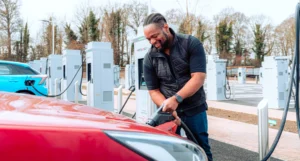
Charging speed also shapes demand. In BMW’s poll, 53 per cent said adding about 150 miles (about 240 km) in 10 minutes would make them more likely to consider an EV. That rises to 70 per cent of Gen Z and falls to 30 per cent of Baby Boomers. BMW estimates its new iX3 can add 185 miles (about 300 km) in 10 minutes at an 800V station.
How do you work out your own number?
Start with the longest drive you make more than a few times a year. Then add a margin for whatever shrinks range, starting with cold weather. The IEA says real-world measurements typically show a 20 to 40 per cent loss in cold winter conditions. Telematics firm Geotab analysed 5.2 million trips. Range peaked at 21°C and averaged about 54 per cent of the rated figure at -15°C. Preconditioning the car while it’s plugged in helps, and so do heated seats. Heat also cuts range, although by less. In tests on five EVs in 2019, US motoring group AAA found range fell 17 per cent at 35°C with the air conditioning on, compared with driving at 24°C.
Battery ageing adds a smaller margin. Geotab’s analysis of more than 22,700 EVs found average degradation of 2.3 per cent a year. That leaves a projected 81.6 per cent of capacity after eight years. Charging habits affect that rate. Cars relying heavily on high-power fast charging lost 3.0 per cent a year. Those using mostly lower-power charging lost 1.5 per cent. Heat speeds up ageing too: cars in hot climates degraded 0.4 per cent a year faster than those in mild ones.
A short daily drive stays simple if you can plug in near home or work. In BMW’s survey, 23 per cent cite access to convenient home charging as a barrier. Another 24 per cent cite public charging availability. Drivers without home charging will visit public chargers less often with a bigger battery, so extra range may earn its cost.
Finally, compare the answer with your budget. BMW’s respondents named purchase price as the biggest barrier, at 51 per cent, while 24 per cent named driving range. Someone who makes one long trip a year can set a long-range model’s higher price against a longer charging stop. Someone who regularly drives 300 km in winter has a stronger case for paying more.