
Partner content with VinFast and Al Tayer Motors
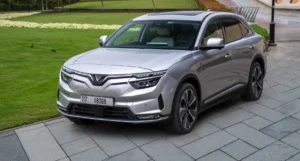
Al Tayer Motors markets the VinFast VF 8 in the UAE as a sustainably focused eSUV with vegan leather seats. You may not think that specifying this seat covering could result in big emissions savings, but new research suggests it has a large, positive impact.
Why has vegan leather suddenly got a stronger case?
Researchers have recently produced new data that reflects very well on vegan leather. A team at Cornell and New York University recalculated leather’s farming-phase emissions using UN Food and Agriculture Organization livestock data. Writing in ACS Sustainable Chemistry & Engineering, they landed on 187.1kg carbon dioxide equivalent emissions (CO2e) per kg of finished bovine leather. Vegan alternatives averaged 14.9kg. That’s more than a twelvefold gap, and it’s about 70% wider than the industry’s previous working figure.
The study validates the carbon advantage of vegan leather as a whole category, rather than being specific to the VinFast product.
But the sums are still fun to run. A five-seat SUV interior takes roughly 10 square metres of trimmed hide. At normal automotive thickness, that’s around 8.5 kg of material. So a leather cabin arrives carrying about 1.6 tonnes of CO2e, while a vegan one carries closer to 0.13 tonnes. Call the difference 1.4 tonnes per car.
That’s an EVLife estimate rather than a VinFast figure. Even allowing for that, 1.4 tonnes roughly equates to 13,000 km of UAE driving in the VF 8 itself. That’s a big carbon saving.
How much carbon goes into building the car itself?
A few tonnes, and most of it is accounted for by the battery. The VF 8 runs an 87.7 kWh nickel-manganese-cobalt pack. Work published in Nature Communications puts NMC811 cells at a median 74kg CO2 per kWh, with a spread from 59 to 115. That means the VF 8 pack accounts for around 6.5 tonnes of carbon dioxide, inside a plausible 5.2 to 10.1 tonne band.
Line the two up and the interior saving is worth about a fifth of the battery’s production footprint.
VinFast assembles the car in Vietnam, where the grid still leans on coal, so factory emissions run higher than they would elsewhere. But the company is working on that. Its 2024 figures for the Hai Phong complex include a 30 MWp rooftop solar project, 2.7 million kWh of electricity saved and an 89.2% waste diversion rate, all sitting under a Net Zero 2040 target.

How clean is the VF 8 to drive in the UAE?
Cleaner than most people assume, and improving each year. The US EPA rates the 2025 VF 8 Eco at 46.2 kWh per 100 miles measured at the socket, including charging losses, which works out at 28.7 kWh per 100 km.
Then there’s the grid. The UAE now generates electricity at 359 gCO2eq per kWh, with 28% coming from low-carbon sources. Barakah nuclear supplies close to a fifth of the national total and solar adds more than 8%. Plug the VF 8 into that and it emits roughly 103g of CO2 per km in use.
For comparison, a petrol SUV drinking 9.5 litres per 100km puts out about 219g per km from the exhaust. If you include the fuel’s production and you’re nearer 265g. So the VF 8 cuts driving emissions by somewhere between half and 60%.
That trails the 73% the ICCT found for European battery cars last year, which reflects Europe’s cleaner grid rather than anything about the car. As UAE solar and nuclear keep scaling, the gap keeps closing. The ICCT put European break-even at around 17,000km. On UAE numbers, the VF 8 clears its production carbon inside one to three years of ordinary driving.
Is it efficient enough?
It’s not at the top of its class, but at 3.5 km per kWh the VF 8 asks more of the grid per kilometre than several rivals. Kelley Blue Book, the long-established American vehicle valuation and reviews guide, rates its EPA range of up to 256 miles, about 412 km, as acceptable rather than outstanding, with competitors clearing 300 miles or 483 km.
That matters less than it might sound, because the electricity supply contributes most of the impact. Charge at home on rooftop solar and the efficiency question largely goes away. But generally speaking, buyers who care about their carbon should think as hard about where their kilowatt-hours come from as about the badge on the bonnet or car specifications.
Can you check these numbers yourself?
Yes, quite easily. The leather comparison is simple multiplication. Take 187.1kg CO2e per kg for hide against 14.9kg for the vegan equivalent, then apply your own view of how much a cabin uses.
Trade sources put a full SUV interior at two to two and a half hides of roughly 3.7 to 4.6 square metres. At 1 mm thickness, automotive leather weighs about 0.85kg per square metre. Change either assumption and the answer moves, though the relative difference never does.
For the whole-vehicle picture, the IEA publishes a free EV Life Cycle Assessment Calculator. Set battery size, annual mileage, lifetime and grid carbon intensity, then compare against a petrol equivalent. Enter 87.7 kWh and 359 gCO2eq per kWh and you’re modelling something close to a UAE VF 8. Grid figures update annually, so the calculation is worth repeating occasionally, or whenever you’re about to choose a new car.

So where does that leave the VF 8?
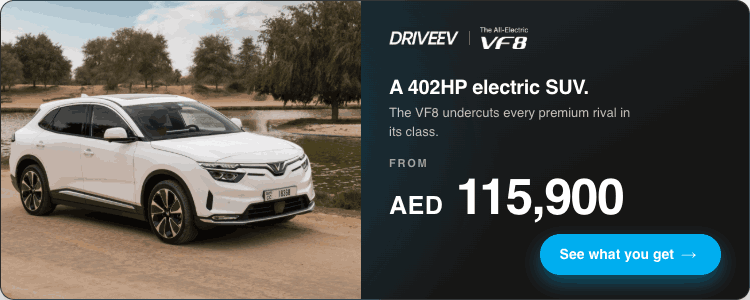
In decent shape, on the evidence available. Al Tayer lists it at AED 115,900 for the Eco and AED 125,900 for the 402 hp Plus, quoting up to 493 km of range (note the EPA figure for the US Eco is 412km as mentioned previously).
The material choice is the genuinely interesting part. In the UAE, it’s worth around 1.4 tonnes of avoided carbon before the car moves a single centimeter, on a grid that gets cleaner every year. The VF 8 isn’t the most frugal electric SUV you can buy in the UAE. On the seats, though, the science is now firmly on its side.